Keyword research: a step-by-step guide that ends in a page plan, not a spreadsheet
Keyword research is not a list of 500 words. It is a map of which search intent belongs on which page. Five steps, the tools worth using and how to prioritise what you find.
SEO6 min read

Keyword research is finding the words and phrases your customers type into Google, and deciding which page on your site answers which group of those searches. The output should not be a spreadsheet of 500 keywords; it should be a map: this group of searches goes to this page, and this is what that page needs to be the best answer. Search intent matters more than search volume, and the fastest wins usually sit on keywords where you already rank between positions 8 and 20.
Here is the process we use for clients, with tools that are free or close to it.
Key takeaways
- Start from the customer, not the tool: how would they describe the problem you solve?
- Intent beats volume: "price" and "near me" bring buyers, "what is" brings readers.
- Cluster keywords into pages: one group of searches, one page.
- Prioritise by business value, realistic chance and quick wins, not by the biggest number.
- For other countries and languages, research each market separately. Translation is not research.
Step 1: a list of seed topics
Write down 10 to 20 topics the way a customer would say them, not the way your company names them internally. A dentist says "prosthodontics", a patient types "how much does a crown cost". Good sources:
- questions customers ask by phone and email
- Google autocomplete suggestions as you type
- the "People also ask" box under the results
- forums, Reddit threads and review sites where your audience talks
- queries in Google Search Console, if the site already exists
Step 2: expand with tools
| Tool | What for | Cost |
|---|---|---|
| Google Search Console | words you already appear for | free |
| Google Keyword Planner | volume estimates and ideas | free with an Ads account, in ranges |
| Google Trends | seasonality, comparing two terms | free |
| Ahrefs, Semrush | volume, difficulty, competitors' keywords | paid |
| Autocomplete and "People also ask" | natural language and long-tail phrases | free |
Volume numbers are estimates. In smaller markets and niche B2B topics, paid tools often show zero where real demand exists. Do not drop a keyword because a tool says "0 to 10" if Google suggests it and your customers use it.

Step 3: search intent
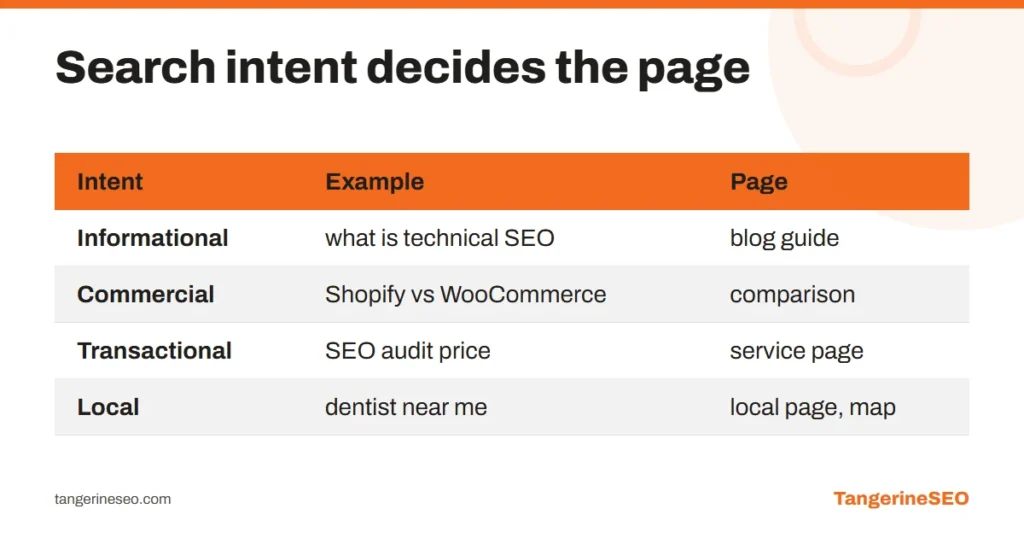
Every keyword carries an intent, and the intent decides what kind of page can rank.
| Intent | Example | Page type |
|---|---|---|
| Informational | "what is technical SEO", "how to clean an AC unit" | blog article, guide |
| Commercial | "best SEO agency for SaaS", "Shopify vs WooCommerce" | comparison, review |
| Transactional | "SEO audit price", "hire Shopify developer" | service or product page |
| Local | "dentist near me", "plumber Brooklyn" | local page, Google Business Profile |
The most common mistake is trying to rank a blog post for a transactional keyword, or a service page for a "what is" query. Look at the top ten results: if they are all guides, a service page will struggle to get in, and the other way round.
Step 4: cluster keywords into pages
Keywords with the same intent and the same answer belong on the same page. An example for an SEO agency:
| Cluster | Keywords | Page |
|---|---|---|
| Audit price | seo audit cost, how much is an seo audit, seo audit pricing | pricing section or audit service page |
| Audit how-to | how to do an seo audit, seo audit checklist, diy seo audit | blog guide |
| Ecommerce SEO | ecommerce seo, seo for online stores, product page seo | service page plus guide |
| Shopify | shopify seo, shopify seo agency | platform service page |
Two pages targeting the same cluster compete with each other, and usually neither ranks well. When two pieces chase the same thing, merge them or split the intent clearly. How to connect pages so Google understands which one leads is covered in our internal linking guide.
Step 5: prioritise
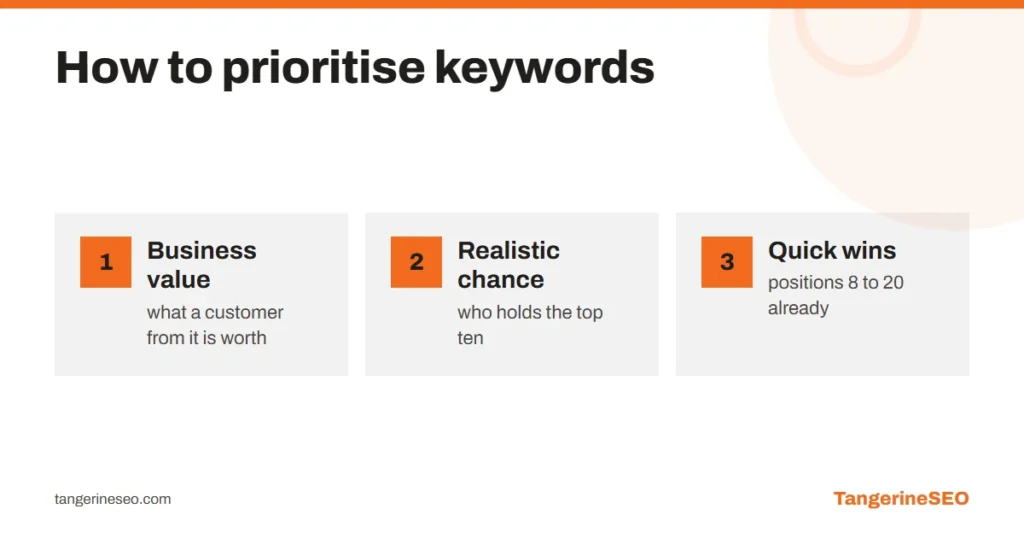
Do not start with the biggest keyword. Start where three things overlap:
- Business value: what a customer from this keyword is worth.
- Realistic chance: who holds the top ten and how strong they are.
- Quick wins: keywords where you already sit at positions 8 to 20, visible in Search Console.
Positions 8 to 20 are the fastest money in SEO. The page exists, Google already rates it, and it needs better content, a sharper title and a few internal links. More on that in how to rank first on Google.
Keyword research for other markets
If you sell in several countries, translated keywords are not keyword research. People in Germany, the UK and the US use different words for the same thing, and search volume differs even in the same language. Each market gets its own seed list, its own intent check and its own top-ten review. This is the core of our international SEO and multilingual SEO work.
What happens after the research
The keyword map becomes a plan: which pages get fixed, which get written and in what order. Each page gets one main cluster, and the title, H1, subheadings and copy follow that intent. That is on-page SEO, and the whole process from research to results is in how SEO is done.
If you would rather have us do the research, with a page map and priorities, that is our keyword research service.
Frequently asked questions
How do you do keyword research?
Start from topics in your customers' words, expand them with Search Console, Keyword Planner and search suggestions, check the intent of each keyword, cluster them into groups and assign each group to a single page.
What is the best free keyword research tool?
Google Search Console for words you already get impressions for, and Google's own autocomplete and "People also ask" for natural customer language. Keyword Planner gives rough volume ranges with a free Ads account.
What is search intent?
The goal behind a search: learning something, comparing options, buying, or finding something nearby. Intent decides which type of page can rank for a keyword.
How many keywords should one page target?
One main cluster of keywords with the same intent. That cluster can include ten variations and synonyms, as long as they all ask the same question.
Why does a tool show zero volume for a keyword people use?
Because tools estimate volume from samples, which are thin in smaller markets and niche topics. If Google suggests the phrase and customers use it, demand exists even if the tool cannot see it.
If you have a site and are not sure which words it should rank for, get in touch through our contact page. Packages and prices are on the pricing page.