Link building strategies that still work, and the ones that waste money
A handful of relevant, editorial links beats hundreds of cheap ones. Where good links come from, how to spot spam before you pay for it and how many links a month is realistic.
SEO5 min read

Link building is earning links from other websites to yours, because Google still treats those links as one of its strongest trust signals. The strategies that still work have one thing in common: the link exists because it is useful to the reader of the linking page. Expert contributions, data-led PR, partner and supplier pages and industry associations all qualify. Packages of "100 backlinks for $50" do not; at best Google ignores them, at worst they trigger a manual action.
Here is what works, what does not, and how to tell the difference before you pay.
Key takeaways
- Quality over quantity: relevance, real traffic and an editorial placement.
- Strategies that work: expert articles, original data, digital PR, partners, associations, unlinked mentions.
- Spam to avoid: link packages, private blog networks, mass link swaps, comment links.
- Most small and mid-size businesses need 4 to 10 good links a month, not hundreds.
- Links amplify a site that is already technically sound and useful.
What makes a link good
| Quality | Good link | Bad link |
|---|---|---|
| Relevance | a site about your topic or your city | a site about everything |
| Traffic | a real audience | exists only to sell links |
| Placement | in the body copy, in context | in a footer, in a list of 50 links |
| Reason | useful for the reader to click | the only reason is SEO |
| Anchor text | natural, often the brand name | always the exact keyword |
Before you agree to a link, open the site as a reader. If you would never read it, and every post is a "guest post" linking to casinos and supplements, it is not a place for you.

Link building strategies that work
Expert contributions
An article with real expertise on a site in your industry: a lawyer writing for a business publication, an HVAC firm writing for a home improvement site. The test is that the article would be worth publishing without the link. Editors accept such pieces, and the link is a natural part of the byline or context. This is our guest posting service.
Original data and digital PR
Journalists link to sources. A survey of your customers, pricing data from your market or an analysis nobody else has is the strongest link magnet there is. A press release without news ends up in the bin. More on this on our PR and SEO page.
Partners, suppliers and clients
Companies you already work with often have partner, reference or "where to buy" pages. A distributor, a manufacturer whose products you install, a client whose project is visible. These links are easy to get and entirely natural.
Associations, events and sponsorships
Membership in trade bodies, sponsoring a local club or event, speaking at a conference. Each usually comes with a link from a site Google already trusts.
Unlinked mentions
Search for your brand name. Wherever someone mentions you without a link, a polite email asking to add one has a high success rate, because the editor already chose to mention you.
What not to do
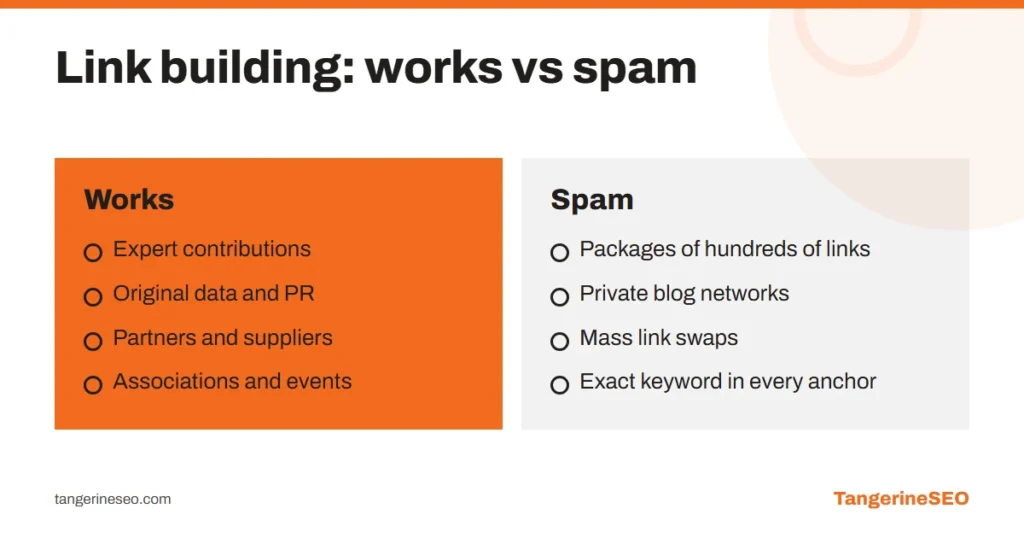
- Link packages of hundreds of links from unknown sites. Cheap to buy, slow and costly to clean up.
- Private blog networks built only to sell links. Google recognises the pattern.
- Mass link exchanges with dozens of sites.
- Comments and forum posts made only for the link.
- The exact keyword in every anchor. Natural links mostly carry the brand name, the URL or a description.
The consequence is not always a penalty. More often Google simply ignores such links, so you paid for nothing. But manual actions exist and appear in Search Console under Manual actions, as covered in our Search Console guide.
How many links you need and how long it takes
There is no universal number. Look at competitors: how many quality domains link to the sites ranking above you for the keywords you want. If they have 30 to 50 good referring domains and you have five, that is the gap.
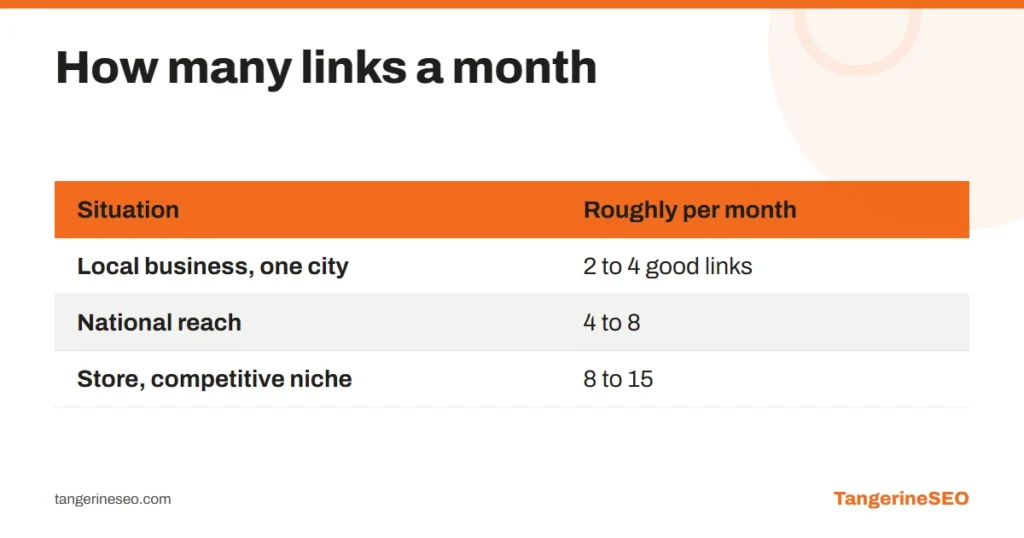
| Situation | Roughly per month |
|---|---|
| Local business, one city | 2 to 4 good links |
| National reach | 4 to 8 |
| Online store in a competitive niche | 8 to 15 |
Our Growth package includes 4 links a month and Dominance includes 10. The first effect usually shows within two to four months, and the full effect takes longer because Google reassesses pages gradually. Why SEO takes as long as it does is explained in how long SEO takes.
Links are not step one
Links amplify what a site already offers. If the site is slow, the pages thin and the internal linking chaotic, external links achieve little. The order that makes sense: technical health, strong content on the right pages, internal linking, then serious link building. The difference between work on the site and off it is covered in on-page vs off-page SEO.
Frequently asked questions
What is link building?
Earning links from other websites to yours. Google uses those links as a trust signal, so pages with more quality links tend to rank better.
Is buying links allowed?
Google's guidelines prohibit buying links that pass ranking signals without being marked. Paid placements should be labelled. Packages of hundreds of links from unknown sites are a risk and usually deliver nothing.
How many backlinks do I need per month?
It depends on competition. A local business often needs 2 to 4 good links a month, a national business 4 to 8, and an online store in a competitive niche more.
How do I recognise a bad link?
The site has no real audience, covers every topic, publishes many guest posts with unrelated links, and places your link in a footer or a long list. If you would not read the site, the link is not worth having.
How fast do backlinks work?
The first effect usually appears within two to four months, provided the site is technically sound and has useful content.
If you want us to compare your link profile with your competitors' and show what is missing, that is part of our off-page SEO service. Packages with link building are on the pricing page.